

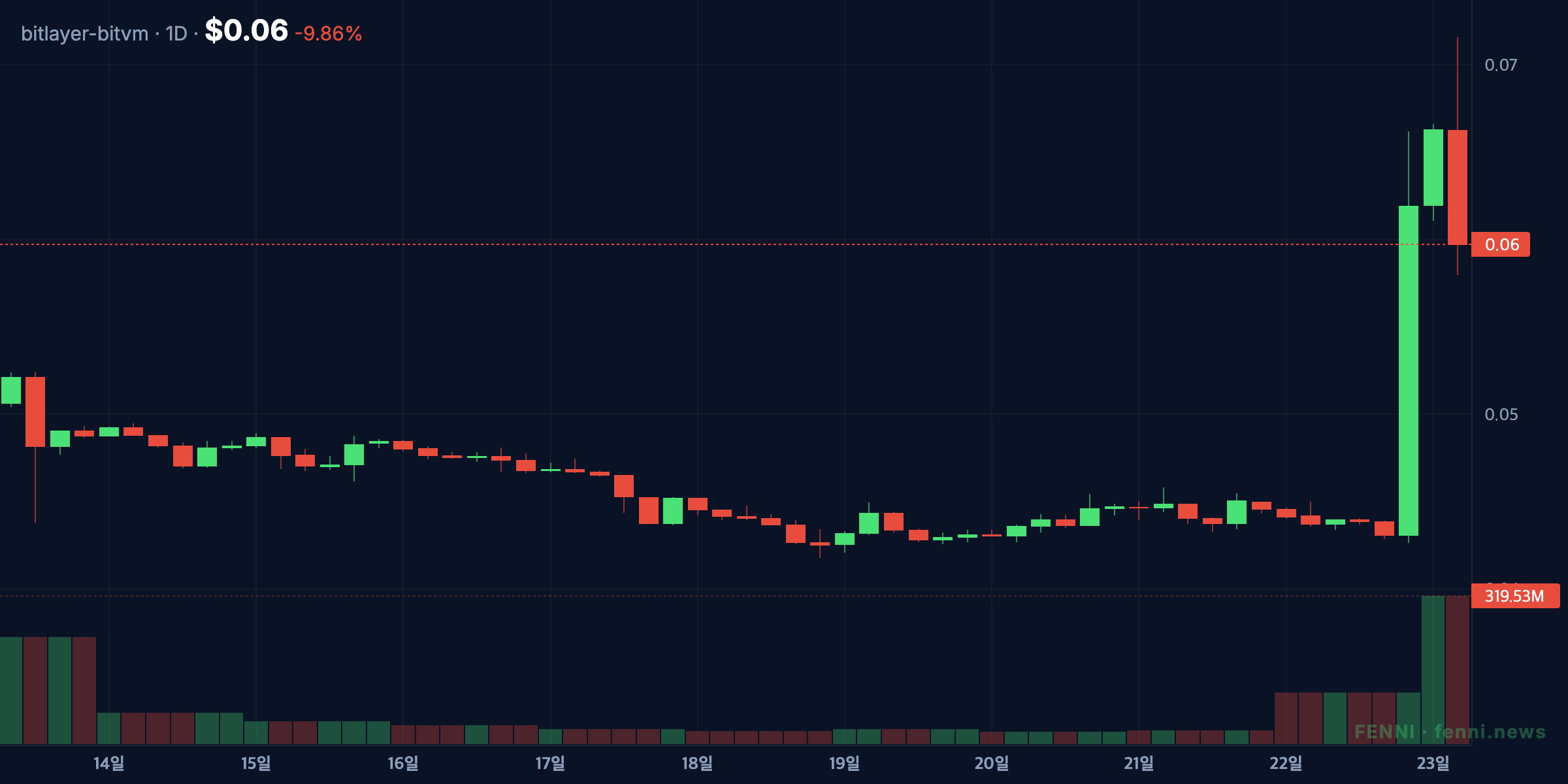
As of October 23, 2026, CoinMarketCap records BTR, the token of the Bitcoin-focused Layer 2 project Bitlayer, at $0.06128 with a market capitalisation of $20.42M and $48.73M of trading volume. Those figures come from a snapshot captured at 07:01 UTC on October 23, 2026, and the 24-hour figures beneath them describe the rolling window from roughly 07:01 UTC on October 22 to that capture time. Over that window CoinMarketCap put the token up 40.76%. A move of that size on a token this small is the reason BTR is worth examining now: the price change is well documented, but its cause is not stated in any of the published material reviewed for this article, and the project’s own description of itself is the only account available of what the network is meant to do. This overview separates the two.
Key Takeaways
- ■ Bitlayer describes itself as the first rollup solution purpose-built for Bitcoin, a self-description published in its own documentation rather than an independently established fact.
- ■ The project’s documentation lists a live first-generation chain, Bitlayer PoS (V1) launched in early April 2024, and a second-generation Bitlayer Rollup (V2) under development.
- ▲ In the rolling 24-hour window to the 07:01 UTC snapshot of October 23, 2026, CoinMarketCap records BTR up 40.76% on $48.73M of volume against a $20.42M market capitalisation.
- ▼ The same snapshot places BTR 74.01% below its February 15, 2026 record high of $0.2371, so the move occurs inside a deep drawdown.
- ▼ Only about 33% of the one-billion BTR supply circulates, leaving the fully diluted valuation at $61.28M against a $20.42M market capitalisation.
What is Bitlayer?
Bitlayer is a project that builds a Layer 2 network for Bitcoin, and its own documentation supplies the framing. Bitlayer’s documentation states: “As the first rollup solution purpose-built for Bitcoin, Bitlayer harnesses the strength of Bitcoin’s base layer, ensuring that its operations inherit the same level of trust, decentralization, and resilience that have made Bitcoin the most secure blockchain in existence.” The same page sets out the problem the project targets: Bitcoin’s base layer limits transaction capacity and fees, it does not natively support smart contracts, and it has no native mechanism for trustless interoperability with other chains.
What the documentation claims for the design is that Bitlayer extends Bitcoin’s functionality with Turing-complete programmability, is built on the BitVM paradigm, and is fully compatible with the Ethereum Virtual Machine so that developers can migrate applications from Ethereum without significant modifications. All of those statements are the project describing its own architecture; no node-level audit or third-party technical assessment is cited in this article.
The distinction matters for a reader. “First rollup purpose-built for Bitcoin” is a competitive superlative the project assigns to itself. Nothing in the material reviewed here establishes the ranking, and this article does not assert it. Bitlayer’s positioning as a Bitcoin scaling layer is real in the narrow sense that the project publishes a roadmap for it, not in the sense that an outside standard has been met.
Overview
The documentation’s own status section separates two generations of the network rather than describing one. Bitlayer PoS (Mainnet-V1) launched in early April 2024 and is described as live and operational, with a testnet available for developers. Bitlayer Rollup (Mainnet-V2) is described as an upgrade currently under intensive development, and the project states that it has launched a testnet for the BitVM Bridge enabling the secure bridging of BTC assets, with that testnet to be upgraded to support the rollup architecture. The documentation also maintains a separate BTR Token Overview page in its navigation.

Supply structure comes from CoinMarketCap’s Bitlayer page, and those figures explain the gap between the two valuations. The page lists a total supply and a maximum supply of 1,000,000,000 BTR each, against a circulating supply of 333,285,907 BTR, which it gives as 33.3285907% of supply. Market capitalisation is therefore $20.42M while the fully diluted valuation is $61.28M, three times larger. The page also lists 44.21K holders and a CertiK rating of 3.9, and it tags the asset to the Bitcoin ecosystem.
Separately, Bitlayer’s homepage publishes headline statistics about the broader ecosystem, which are a different kind of information from the token data above. Because the homepage states no measurement window for those tiles and they do not reconcile with CoinMarketCap’s $48.73M of 24-hour BTR volume, this article does not repeat them as figures and notes only that such claims exist on the project’s own site. Treating them as token-level metrics would be wrong, and treating an unattributed tile as a verified measurement would be worse.
Price Outlook
Any statement about where BTR is priced has to belong to a dated snapshot, and this one does, according to CoinMarketCap as of October 23, 2026, which recorded BTR at $0.06128 with a market capitalisation of $20.42M.
According to the same CoinMarketCap page as of October 23, 2026, the token is up 40.76% over the 24 hours preceding the 07:01 UTC capture, with 24-hour volume of $48.73M against a volume-to-market-capitalisation ratio of 238.85%.
That ratio is the number worth sitting with, according to CoinMarketCap’s own figures as of October 23, 2026: $48.73M changed hands against a $20.42M market capitalisation, meaning the reported 24-hour volume is about 2.4 times the entire value of the circulating float as the page valued it.
The range inside that window, according to the same page as of October 23, 2026, ran from a low of $0.04261 to a high of $0.0716, a high-low spread equal to about 68% of the low across the same 24 hours.
Longer horizons put the move in context, according to the same CoinMarketCap page as of October 23, 2026. As of October 23, 2026, that page records an all-time high of $0.2371 on February 15, 2026, which leaves the snapshot price 74.01% below that level, and an all-time low of $0.01586 on July 18, 2026, which leaves the snapshot price about 3.9 times above that low, computed from the two dollar figures the page lists, according to that same page.
No price level is offered here, as of October 23, 2026, because the dated CoinMarketCap snapshot supports arithmetic against two named dates and a turnover ratio, and according to that page nothing more.
Risks and what to watch
The first consideration is what the numbers above actually measure, according to CoinMarketCap’s figures as of October 23, 2026. A volume-to-market-capitalisation ratio of 238.85% describes trading relative to the size of the float, and a high-low range equal to roughly 68% of the low describes price volatility inside the same window; neither observation establishes who bought, who sold, or what the order book looked like. Beyond those two measured facts, general risk possibilities for a small-capitalisation token remain open: a thin float can move sharply in either direction, and a leveraged market can liquidate positions quickly, as the next paragraph describes for the wider market. This article does not claim the snapshot proves any of that happened to BTR.
The second consideration is supply. CoinMarketCap lists circulating supply of 333,285,907 BTR against a total and maximum supply of 1,000,000,000 BTR each, with the figures captured on October 23, 2026, and the fully diluted valuation of $61.28M against the $20.42M market capitalisation means two-thirds of the eventual supply sits outside the current float. Whatever schedule governs the release of that remainder, the dilution it represents is a standing consideration independent of any single day’s gain.
The third consideration is borrowed from the wider leveraged market rather than from Bitlayer itself. CoinDesk reported on Oct. 21, 2026 that Monero futures open interest had surpassed $300 million, nearing January’s record of about $320 million, and its account of the mechanism applies to any thin, sharply moved asset: “In such cases, a slight price decline can trigger mass liquidation of longs and a price crash,” CoinDesk wrote. That reporting concerns monero only and says nothing about Bitlayer; it is reproduced here as a market-wide caution, not as a claim about BTR.

A fourth consideration is where the evidence sits. Every product statement in this article comes from pages Bitlayer publishes about itself, and the V2 rollup is described by the project as under development. Roadmap execution is therefore an assertion about future delivery, and the ecosystem statistics on the homepage carry no measurement window and are unverified by any party other than their author. What to watch is whether the project publishes an independently measured, windowed figure for the activity its homepage describes, and whether the V2 upgrade moves from testnet to mainnet with the bridging it is meant to carry.
Frequently asked questions
What is Bitlayer and what is BTR?
Bitlayer is a Bitcoin Layer 2 project whose documentation describes it as a rollup purpose-built for Bitcoin, built on the BitVM paradigm and compatible with the Ethereum Virtual Machine. BTR is the token the project presents as the ecosystem’s native asset, documented on a separate BTR Token Overview page. The description of the network is the project’s own.
How much did BTR move, and over what window?
According to CoinMarketCap’s snapshot captured at 07:01 UTC on October 23, 2026, BTR rose 40.76% over the preceding 24-hour rolling window, with volume of $48.73M and a volume-to-market-capitalisation ratio of 238.85%. That window runs from roughly 07:01 UTC on October 22, 2026 to the capture time; it is a measured rolling window, not an exchange session and not a multi-day trend.
What are the main risks around BTR?
Three stand out from the data, all per CoinMarketCap for the October 23, 2026 snapshot: a 24-hour volume figure about 2.4 times the circulating market capitalisation, a circulating supply of 333,285,907 BTR against a fully diluted valuation of $61.28M, and a price still 74.01% below its February 2026 high.
What is the distance between BTR’s current price and its all-time low?
CoinMarketCap lists an all-time low of $0.01586 on July 18, 2026 against a snapshot price of $0.06128 as of October 23, 2026, so the snapshot price is about 3.9 times the record low, computed from those two dollar figures. The page’s own percentage label beside that low is an above-the-low return label and is not used here.
Disclaimer: This article is for informational purposes only and does not constitute financial advice. Cryptocurrency investments carry significant risk. Always conduct your own research before making investment decisions.