

As of November 12, 2026, OpenGradient (OPG) is one of the more closely watched names among AI-infrastructure tokens: according to a CoinMarketCap snapshot captured at 07:01 UTC that day, OPG was up 6.26% in the last 24 hours and trading at $0.135601. The project describes itself, on its own website, as a research lab built around private, uncensored and sovereign artificial intelligence. This overview sets out what the project says it is building, how the token’s supply is structured, and what the dated market data actually shows — with every figure anchored to its snapshot and every product claim attributed to the project that makes it.
Key Takeaways
- ▲ As of the November 12, 2026 snapshot, OPG was up 6.26% in the last 24 hours, according to CoinMarketCap.
- ■ According to OpenGradient’s own documentation, the project builds decentralized infrastructure for verifiable AI execution, agent deployment and model hosting.
- ▼ 238,062,500 OPG of a 1,000,000,000 maximum supply was circulating at the November 12 snapshot, according to CoinMarketCap.
- ▼ The snapshot price stood 71.88% below the token’s all-time high of $0.4823 recorded on April 22, 2026, according to CoinMarketCap.
What Is OpenGradient?
OpenGradient’s positioning is stated plainly on its own website. According to OpenGradient’s website, the project opens with the sentence “OpenGradient is a research lab focused on advancing private, uncensored, and sovereign artificial intelligence.” That line is the clearest available statement of intent from the team, and it frames everything else the project puts in front of a reader: privacy, unrestricted access, and control of AI workloads rather than any single application.
The documentation carries the technical version of the same claim. According to OpenGradient’s docs, the network is “Vertically-integrated decentralized infrastructure for secure and verifiable AI execution, agent and application deployment, and AI model hosting.” The word that does the work in that sentence is “verifiable” — the project’s argument is not simply that AI inference can run on a decentralized network, but that the computation can be checked.
A short caveat applies throughout this article. The material available on the project comes from OpenGradient’s own channels — its website and its documentation — and no independent journalism on the token is present in the sources used here. Every product, program, partnership and backer claim below is therefore reported as the project states it, not as an independently confirmed fact, and the market figures come from a single CoinMarketCap snapshot with its own timestamp.
Overview: What the Network Says It Does

According to OpenGradient’s documentation, the platform is organised around a set of interlocking products rather than a single application. The first is the Decentralized Model Hub, which the docs call “A permissionless repository supporting all model architectures. Upload, browse, and use models instantly available for inference on the OpenGradient network.” A second component, MemSync, is a “Long-term memory layer for AI with persistent context management. Automatically extract, organize, and search memories to build personalized AI applications.” Both descriptions are the project’s own wording, presented here as such.
Inference itself is where the project’s confidentiality argument sits. According to the same documentation, Confidential OHTTP Inference lets developers “Use the OpenAI Python SDK with prompts encrypted to an attested TEE and relayed through the OpenGradient Chat API.” In plain terms, the project’s claim is that a prompt is encrypted on the way out and processed inside a trusted execution environment whose integrity can be attested.
The website adds ecosystem claims that sit outside the technical stack. According to OpenGradient’s website, “OpenGradient has been accepted into the NVIDIA Inception Program,” and the same page presents the product line as “100% EVM Compatible”. That page also lists the project’s backers: Balaji Srinivasan, described as an Ex-Coinbase CTO; Illia Polosukhin, described as a Transformer Architecture Co-Inventor and CoFounder of NEAR; Sandeep Nailwal, CEO of Polygon; Ekram Ahmed, Head of Marketing at Celestia; and Bruno Faviero, CoFounder of Magna. Each of those descriptions is the project’s own wording, and none of them is corroborated by a third party in the sources reviewed for this article.
The project also publishes usage counters, and they differ between its own surfaces. The documentation’s status panel lists MODELS 2,000+, DEVELOPERS 100+ and INFERENCES 1M+, according to OpenGradient’s docs, while the website shows 4500 Models, 50,000+ Active Clients and 2M+ zkML Proofs + TEE Attestations, according to OpenGradient’s website. Because the two sets come from different pages and measure different things — models versus proofs, developers versus active clients — they are reported here separately and are not combined into a single growth figure.
Price Outlook
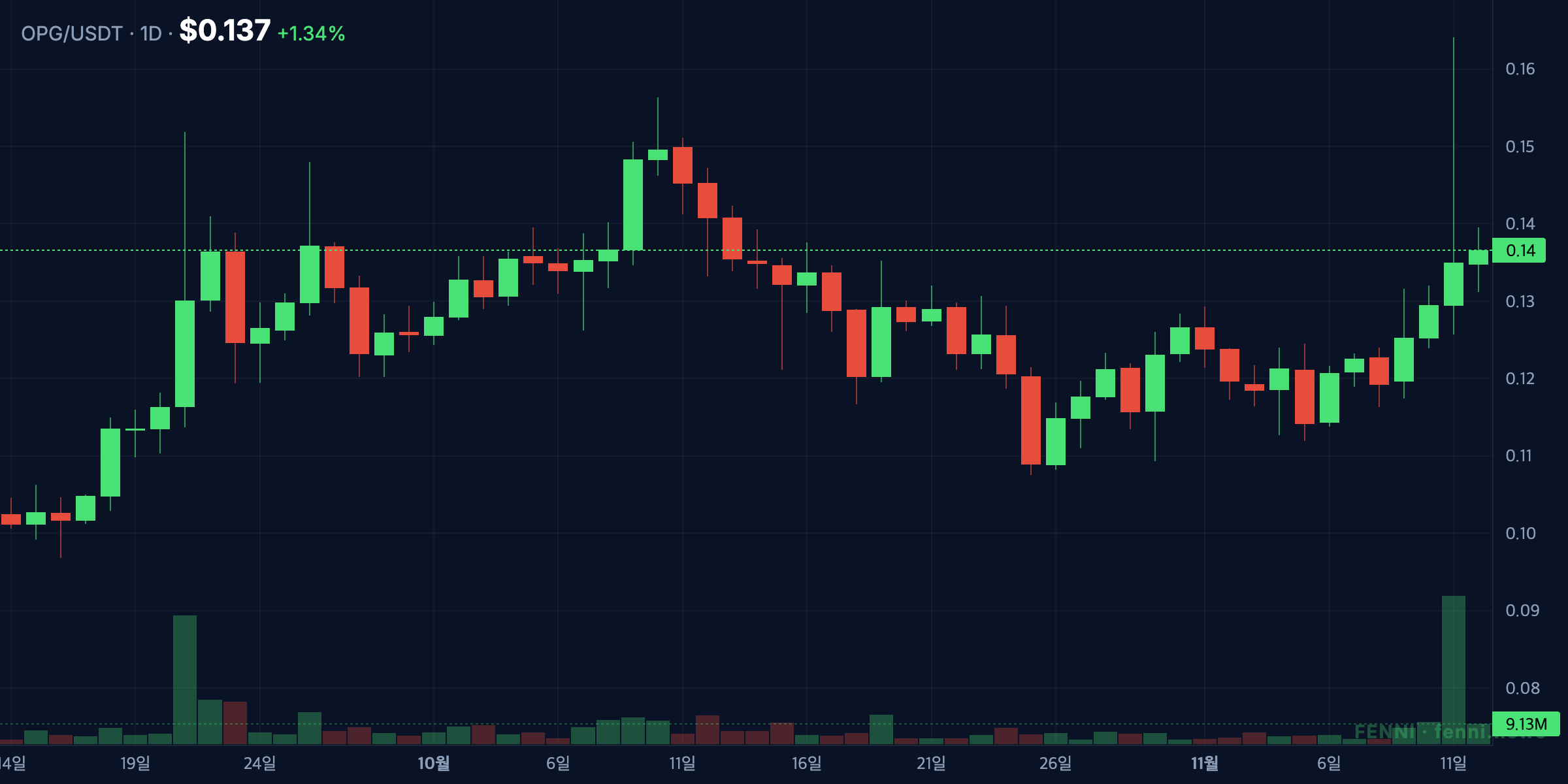
As of November 12, 2026, according to CoinMarketCap, “The live OpenGradient price today is $0.135601 USD with a 24-hour trading volume of $58,027,451 USD.” As of November 12, 2026, according to CoinMarketCap, OPG was up 6.26% in the last 24 hours. As of November 12, 2026, according to CoinMarketCap, the 24-hour low printed $0.1273 and the 24-hour high printed $0.1628, so the 6.26% move was small next to the spread the token covered inside one day.
As of November 12, 2026, according to CoinMarketCap, the statistics block on that page read “Market cap $32.28M 6.26% Unlocked Mkt Cap $36.03M Volume (24h) $58.02M 644.79% Vol/Mkt Cap (24h) 178.89% FDV $135.6M Liq/Mkt Cap 4.36%”. As of November 12, 2026, according to CoinMarketCap, the market cap was therefore $32.28M against a 24-hour volume of $58.02M, and the volume-to-market-capitalisation ratio was 178.89%, the figures the page printed at capture.
As of November 12, 2026, according to CoinMarketCap, OPG had a circulating supply of 238,062,500 coins against a maximum supply of 1,000,000,000 coins. As of November 12, 2026, according to CoinMarketCap, that same statistics block put the fully diluted valuation at $135.6M, roughly 4.2 times the market cap of $32.28M recorded there — a statement of structure rather than a view on where the price should be.
As of November 12, 2026, according to CoinMarketCap, the page’s performance rows show an all-time high of $0.4823 dated Apr 22, 2026 and an all-time low of $0.08165 dated Aug 28, 2026, with changes of 71.88% and 66.07% printed alongside them. As of November 12, 2026, according to CoinMarketCap, the snapshot price therefore sat 71.88% under the April high and 66.07% over the August low, both percentages being the page’s own figures for that capture.
As of November 12, 2026, according to CoinMarketCap, no source reviewed here explains why OPG moved on this window: the page reports the price, volume and supply figures without a stated reason, and the project’s own documentation and website discuss products rather than trading activity. As of November 12, 2026, according to CoinMarketCap, any named trigger would therefore be unsupported, and this article offers none.
Risks and What to Watch
Four structural risks follow from the dated data and the sourcing itself.

Supply overhang comes first. As of November 12, 2026, according to CoinMarketCap, 238,062,500 OPG of a 1,000,000,000 maximum supply was in circulation, which leaves the large majority of the total supply outside the float on that date. The gap between the market cap of $32.28M and the fully diluted valuation of $135.6M, both from the same snapshot, quantifies that difference. This is a statement about structure only — it implies nothing about future price direction.
Drawdown context is the second. As of the same snapshot, according to CoinMarketCap, the price stood 71.88% below the Apr 22, 2026 record of $0.4823, while the 24-hour range ran between $0.1273 and $0.1628. A single-day gain of 6.26% measured against that spread is a modest move inside a much wider drawdown, and a one-day figure is not a trend.
Snapshot volatility is the third. CoinMarketCap’s page is a live feed whose content changed between the first capture and the later verification pass, so every market figure in this article is a dated capture value from November 12, 2026 at 07:01 UTC. The volume-to-market-capitalisation ratio of 178.89% recorded in that snapshot is the data point to watch for OPG, because it describes how much turnover the token carried relative to its size on that date.
The fourth risk is evidence asymmetry. Every product, program, compatibility, backer and positioning claim in this article is project self-published, according to OpenGradient’s website and documentation, and the sources reviewed contain no independent reporting to check those claims against. A reader weighing the project should treat the technology description as the team’s own account, and the usage counters as figures the project publishes about itself.
What is OpenGradient (OPG), and what does the project say it does?
According to OpenGradient’s website, the project says of itself: “OpenGradient is a research lab focused on advancing private, uncensored, and sovereign artificial intelligence.” According to OpenGradient’s docs, the network is “Vertically-integrated decentralized infrastructure for secure and verifiable AI execution, agent and application deployment, and AI model hosting.” Both statements are the project’s own, and no independent assessment of them appears in the sources used for this article.
Where does the market data in this article come from?
The price, volume, supply and ranking figures come from CoinMarketCap, as of November 12, 2026 at 07:01 UTC. That date and timestamp is the anchor for every market number here, including the 6.26% 24-hour change, the $0.135601 price, the $32.28M market cap and the 238,062,500 OPG circulating supply.
What risks apply to OPG?
Risks include a structure in which 238,062,500 OPG of a 1,000,000,000 maximum supply was circulating at the November 12, 2026 snapshot, a price 71.88% below the $0.4823 all-time high of Apr 22, 2026, and an evidence base made up entirely of the project’s own materials, according to CoinMarketCap and OpenGradient’s website.
Disclaimer: This article is for informational purposes only and does not constitute financial advice. Cryptocurrency investments carry significant risk. Always conduct your own research before making investment decisions.