


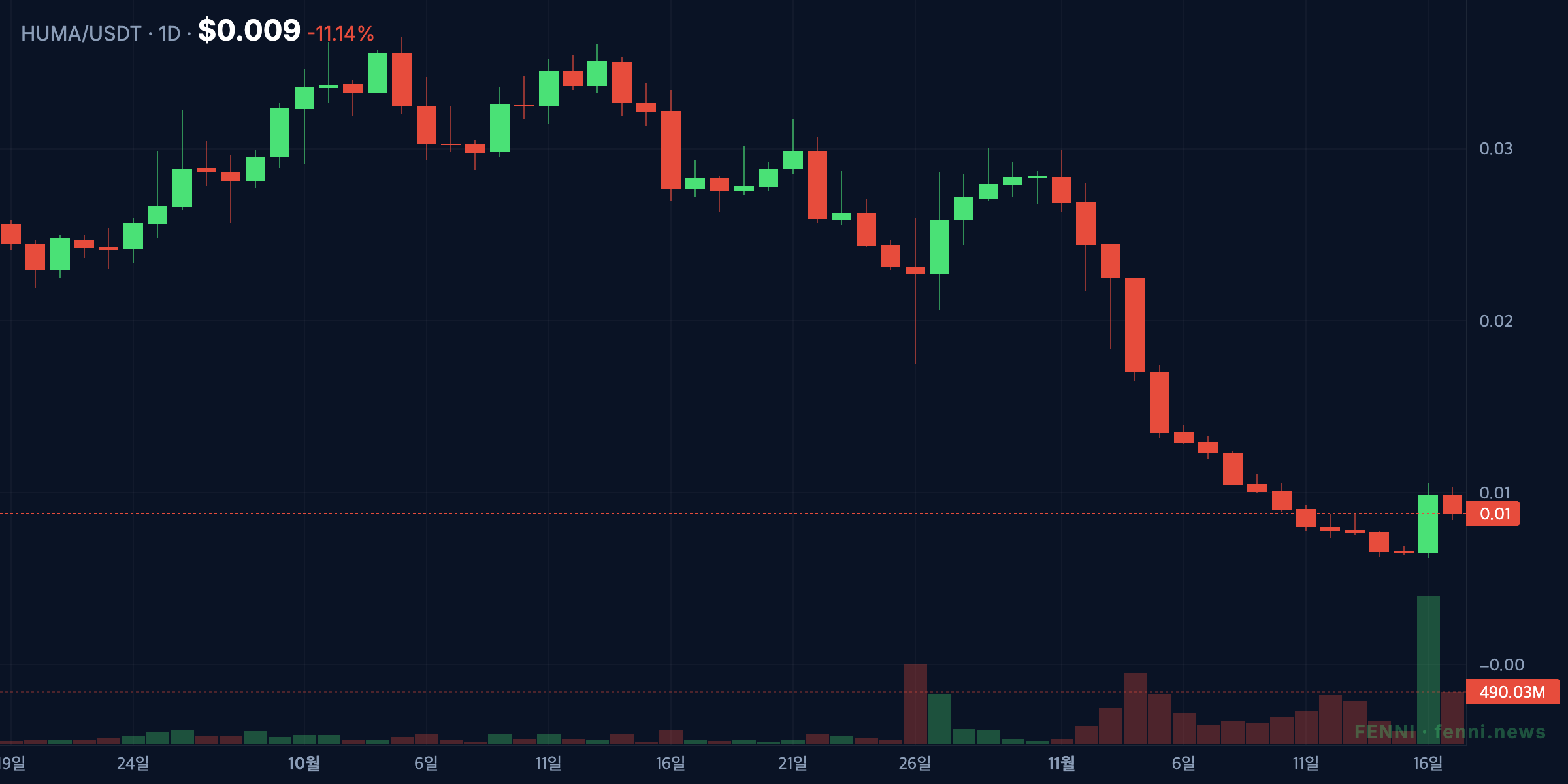
As of November 17, 2026, Huma Finance (HUMA) traded at $0.008620 with a 24-hour trading volume of $97,725,013 and a market capitalization of $30,552,550, according to CoinMarketCap. The same page recorded a 24-hour range of $0.006349 to $0.01046 and an all-time low of $0.006254 on November 16, 2026, one day before the capture. Huma presents itself as payment-financing infrastructure rather than a trading asset: its own website describes a network built to finance payment flows, and its documentation is published as a public GitBook. This overview sets out what the project says it does, the dated market structure around the token, and the points a reader should weigh.
Key Takeaways
- ▲ Huma Finance traded at $0.008620 on November 17, 2026, up 35.73% in the prior 24 hours, according to CoinMarketCap.
- ■ The project describes itself as a payment-financing network whose products include the PayFi Strategy Token at a stated APY of 8%, per huma.finance.
- ▼ Only 3,544,184,892 HUMA circulated on the same dated capture, against a 10,000,000,000 HUMA maximum supply, per CoinMarketCap.
- ■ The cited pages give no reason for the 24-hour move, and no independent reporting on Huma appears in the material used here.

What is Huma Finance?
Huma Finance is a project that, on its own description, builds infrastructure for financing global payment flows. The definition has to be attributed carefully, because the material available comes from the project itself rather than from independent reporting. CoinMarketCap’s listing description of the asset states that Huma Finance is the first PayFi network, powering the financing of global payments with instant access to liquidity – anywhere, anytime. That line is listing text for the asset, not an independently established fact.
The project’s own sense of its scope is narrower and more concrete. Partnering with TradeFlow Capital Management, a Singapore-headquartered specialized investment advisor, Huma finances physical commodities and goods in transit, according to huma.finance. The same page describes cross-border payment financing as Huma’s primary vertical, powered by its Swiss-regulated entity Arf, and says that vertical provides settlement liquidity to licensed financial institutions and money service businesses, enabling T+0 cross-border settlements.
On the headline numbers, huma.finance lists $ 21B+ Total Transaction Volume, $ 420M+ Total Active Liquidity, 3+ Years Onchain Credit Performance and 0% Credit Default. Each of those is the project’s own published claim. The credit-default figure in particular is a performance statement made by the issuer of the product, and nothing in the material reviewed here corroborates it independently, so it is reported as the project’s claim and nothing more.
Overview: how the products and tokens fit together
Huma presents three ways for capital to access the same underlying activity. The first is the PayFi Strategy Token, which huma.finance describes as structured yield powered by cross-border payments and trade finance, at a stated APY of 8%. The second is Huma Prime, which the same page calls a Defensive Looping strategy vault that leverages yield from the PayFi Strategy Token, at a stated APY up to 13.6%. The third is Huma Institutional, aimed at institutional capital providers seeking exposure to payment-flow-backed yield. All three descriptions and both APY figures are the project’s stated product terms as published on its website, captured on November 17, 2026.
The project also explains where it says the yield comes from. Cross-border payment financing runs through the Swiss-regulated entity Arf, and huma.finance says each transactional credit is repaid within 1 to 7 days and backed by funds already deposited into safeguarding accounts. Trade finance runs with TradeFlow Capital Management, where the project says the transactions involve legal ownership of the physical cargo, are fully insured, and typically settle within 30 to 90 days. A third channel covers marketplace payouts in partnership with Geoswift, where the project says it accelerates marketplace sellers’ payouts with stablecoin liquidity available on demand.
For context on the 8% figure, huma.finance publishes a comparison that it says is sourced from RWA.xyz and Galaxy: an 8% Huma PST APY against a 4.6% USDC Lending Rate, a 6.5% Digital Asset Lending rate, a 4.9% Basis Trade rate and a 3.5% U.S. Treasuries rate. The comparison, the benchmarks and the sourcing note are all the project’s own, and a higher stated yield carries the credit and duration exposure of the underlying activity. None of these APYs is a projection for the price of HUMA.
The project’s GitBook serves a public index. According to docs.huma.finance, the complete documentation index sits at llms.txt and each page is also available as Markdown; the site is organised into ABOUT HUMA, ANNOUNCEMENTS, PRODUCTS, ECOSYSTEM and RESOURCES, so the project’s own account of its mechanics can be read in full before relying on secondary descriptions.
The token carries a structure worth stating plainly. As of November 17, 2026, CoinMarketCap recorded a circulating supply of 3,544,184,892 HUMA and a max. supply of 10,000,000,000 HUMA coins, with total supply listed at 9.99B and the circulating share at 35.44%. The same capture put fully diluted valuation at $86.2M against a market cap of $30.55M, and the number of holders at 26.11K. Those are structural figures from a single dated capture, not a judgement about future supply.
Two further fields from the same listing are best kept verbatim rather than merged into one story. CoinMarketCap tags the asset with Solana Ecosystem, Binance Launchpool, Binance Alpha and Airdrops, and it lists a contract reference of 0x9251…5ba8e6 with bscscan.com given as the explorer. A tag list and an explorer reference are different kinds of listing metadata, and neither establishes a single chain or token standard on its own.
Price Outlook
As of November 17, 2026, according to CoinMarketCap, HUMA traded at $0.008620, up 35.73% over the prior 24 hours, and 24-hour trading volume was $97,725,013. As of the same capture date, according to CoinMarketCap, the asset ranked #444 by market capitalization, with a volume-to-market-cap ratio of 319.66% and volume up 1394% on the day. Those readings come from one snapshot, and as of November 17, 2026, according to CoinMarketCap, the page states no reason for the move; no independent reporting on Huma appears in the material used here, so this overview records the figures without naming a trigger, a motive or a mechanism.
As of November 17, 2026, according to CoinMarketCap, an all-time high of $0.06927 on May 27, 2025 left the capture price 87.55% below it, and an all-time low of $0.006254 recorded on November 16, 2026 left the capture price 37.91% above it. As of November 17, 2026, according to CoinMarketCap, the 24-hour range ran from $0.006349 to $0.01046, so the readings are reference points from a single page rather than a direction of travel. As of November 17, 2026, according to CoinMarketCap, a one-day move across that range is not a trend, and nothing in the cited figures links the fresh low and the subsequent move as cause and effect.
As of November 17, 2026, according to huma.finance, the PayFi Strategy Token carried a stated APY of 8% and Huma Prime a stated APY up to 13.6%. Those are product yields on payment and trade-finance activity, published by the project, and they are a different kind of number from a token price: as of that date, according to huma.finance, they say nothing about where HUMA trades. On where the token heads next, the cited material provides no basis for a view, and as of November 17, 2026, according to CoinMarketCap, every figure here is a value recorded on that date that can be expected to have moved.
Risks and what to watch
The first structural risk is supply. Only 3,544,184,892 HUMA circulated on November 17, 2026, against a max. supply of 10,000,000,000 HUMA coins, a 35.44% circulating share, according to CoinMarketCap. The same capture put fully diluted valuation at $86.2M against a market cap of $30,552,550, so a large majority of the maximum supply sits outside the circulating count. How and when the remainder enters circulation is not established in the material reviewed here, and that gap is the clearest structural fact a reader should keep in view.
The second is the scale of the move relative to the size of the market. On the same capture, 24-hour volume of $97,725,013 stood against a market cap of $30,552,550, a volume-to-market-cap ratio of 319.66%, with volume up 1394% and price up 35.73% over the same 24-hour period, according to CoinMarketCap. A day of trading several times the market cap is a distinct market condition from the underlying business of financing payment flows, and the page gives no explanation for it.
The third is the evidence base itself. Every product, yield, partner and performance claim in this overview – the PayFi Strategy Token and Huma Prime APYs, the $21B+ transaction volume, the $420M+ active liquidity, the zero credit default figure, and the Arf, TradeFlow Capital Management and Geoswift relationships – comes from huma.finance or docs.huma.finance, both published by the project. Anyone weighing the credit claims should look for independent verification rather than taking the issuer’s own numbers as settled.
A fourth point is timing. CoinMarketCap recorded the all-time low of $0.006254 on November 16, 2026, and its capture puts the price 37.91% above that low, while the capture price remains 87.55% below the May 27, 2025 all-time high of $0.06927. Watch the depth of the circulating supply, the durability of trading activity, and any independent reporting on the credit book before drawing conclusions from one session.
Frequently asked questions
What is Huma Finance (HUMA)?
Huma Finance is a payment-financing project that describes itself as the first PayFi network, powering the financing of global payments with instant access to liquidity – anywhere, anytime, in CoinMarketCap’s listing description of the asset. According to huma.finance, the project funds cross-border payment financing through its Swiss-regulated entity Arf and trade finance with TradeFlow Capital Management for physical commodities and goods in transit.
How is HUMA’s supply set up?
As of November 17, 2026, according to CoinMarketCap, 3,544,184,892 HUMA circulated against a max. supply of 10,000,000,000 HUMA coins, with a fully diluted valuation of $86.2M against a market cap of $30,552,550. Those are dated capture values and can move with the page.
Why did the HUMA price move?
The material reviewed here gives no reason for the move. As of November 17, 2026, according to CoinMarketCap, HUMA traded at $0.008620, up 35.73% over the prior 24 hours, with 24-hour volume of $97,725,013 and a volume-to-market-cap ratio of 319.66%. The cited page states the figures without attributing a cause.
Disclaimer: This article is for informational purposes only and does not constitute financial advice. Cryptocurrency investments carry significant risk. Always conduct your own research before making investment decisions.