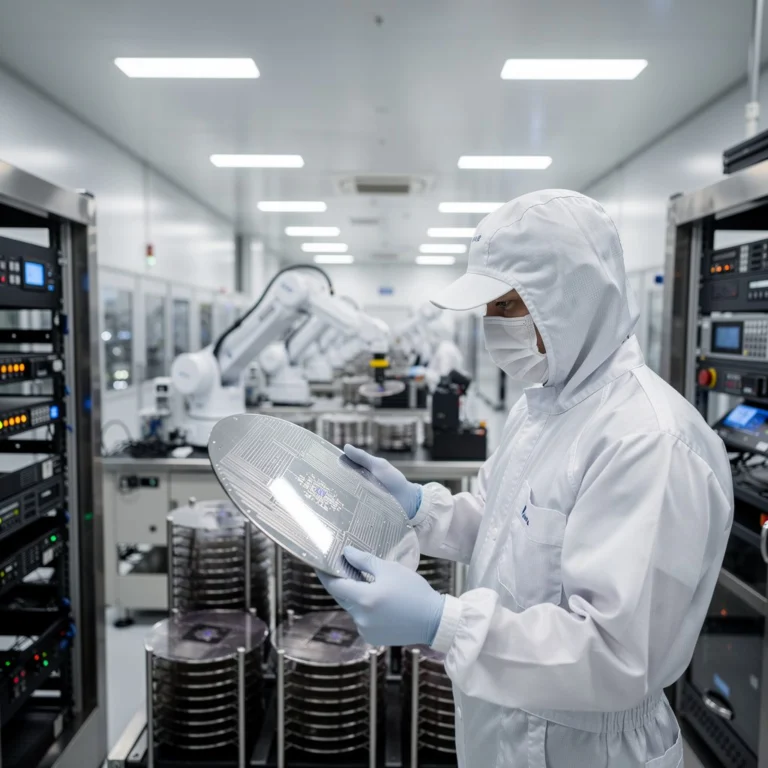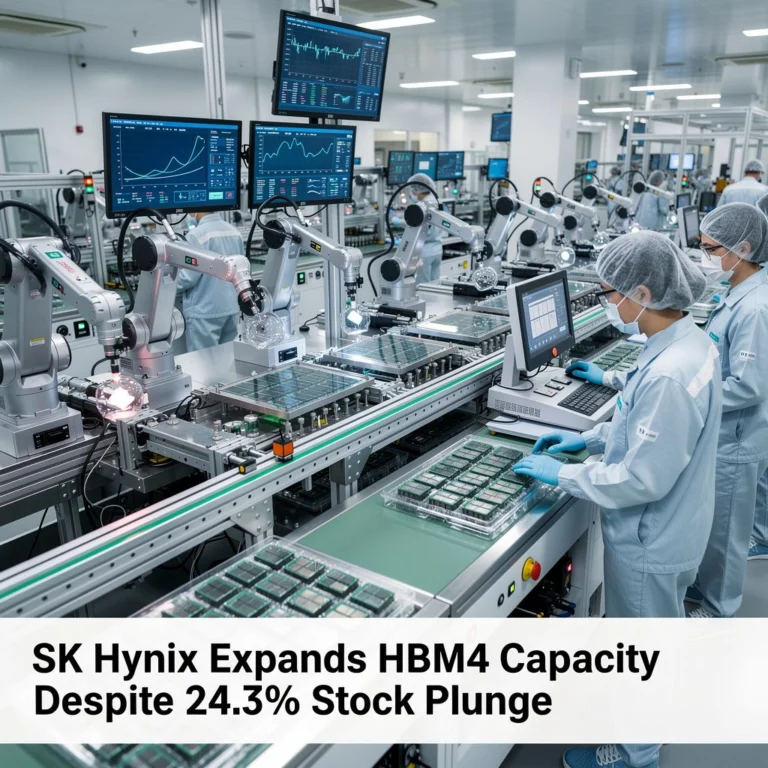

As of November 12, 2026, Samsung Electronics broke ground on “Onyang Line 5,” an advanced HBM packaging plant at its Onyang campus in Asan, south of Seoul. The project commits 46 trillion won across five production lines once the phased build-out is complete, converting a site long used for assembling and testing general-purpose memory into a facility built for AI accelerators. The schedule matters more than the ceremony: the new fab targets operation in June 2028, with HBM mass production from May 2029.
Key Takeaways
- ▲ The Onyang commitment totals 46 trillion won: 6 trillion won of construction plus 40 trillion won of advanced equipment.
- ■ HBM4 stacking rises from 12 to 16 layers with a foundry-logic base die, sharply raising packaging difficulty.
- ■ Counterpoint Research put second-quarter global HBM revenue share at 50% for SK Hynix, 33% for Samsung and 17% for Micron.
- ■ The June 2028 operation target, not the groundbreaking, is where timeline risk sits.
What the 46 Trillion Won Covers
According to Edaily, Samsung is investing 6 trillion won of factory construction cost and 40 trillion won of advanced equipment at the Onyang campus to build five HBM production lines. Kyungje Ilbo reports the Line 5 building is three storeys tall with a cleanroom of about 31,000 square meters, and that on completion campus floor area rises from 270,000 to 420,000 square meters, about 56% more.
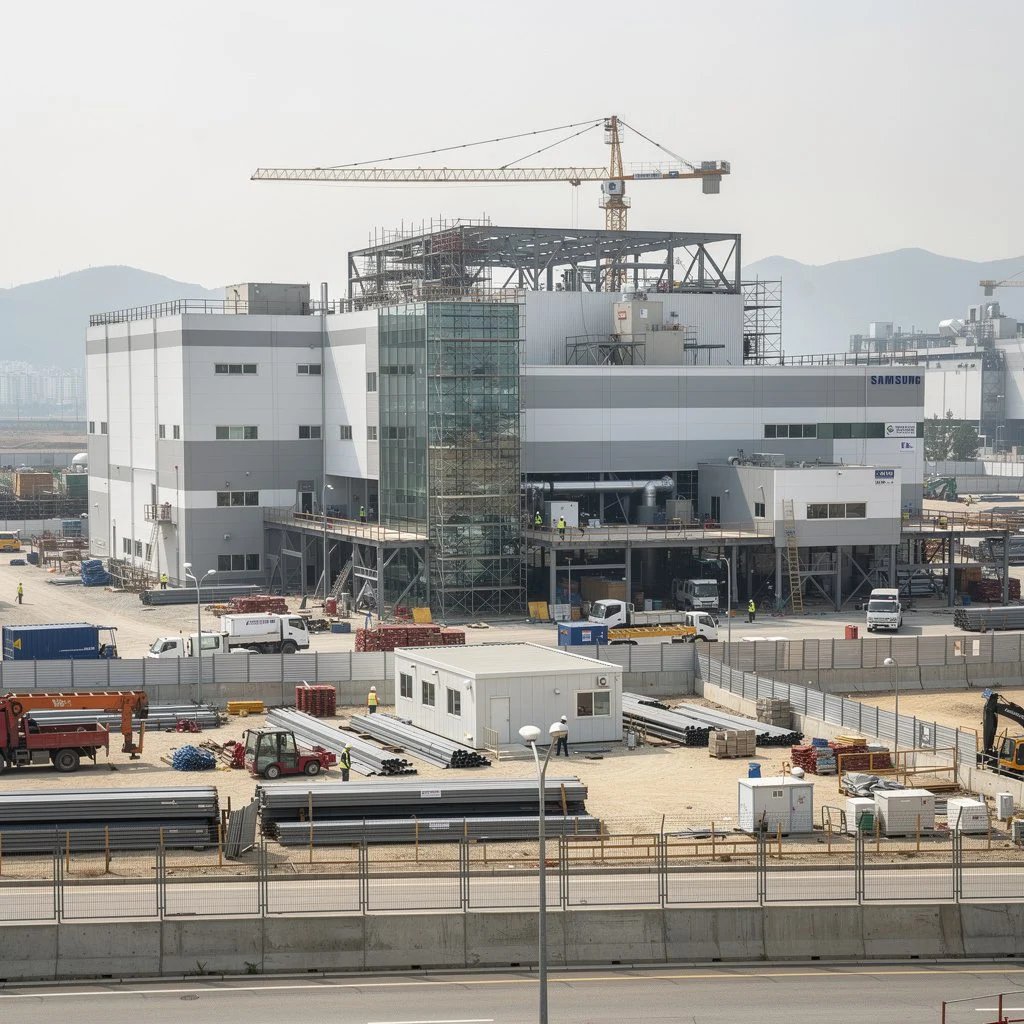
The Onyang figure is one slice of a regional program, and the totals should not be merged. Money Today reports that together with Samsung Electronics’ 60 trillion won, total Chungcheong investment reaches 144 trillion won across Samsung Display, Samsung Electro-Mechanics and Samsung SDI. The 46 trillion won applies only to the HBM lines.
Why the June 2028 Target Is the Real Deadline
Asia Business Daily reports Samsung is to begin operating the new lines in June 2028 and start HBM mass production in May 2029. Edaily makes the supply-side case for the site switch: producing memory dies is not enough, because without packaging capability that completes them into HBM products, final supply cannot be raised enough.
중장기적으로는 온양캠퍼스에 공장 건설비 6조원과 첨단 장비 투자비 40조원 등 총 46조원을 투입해 HBM 생산라인 5개를 구축한다.
Translation: over the medium term, a total of 46 trillion won — 6 trillion won of factory construction and 40 trillion won of advanced equipment — will be invested at the Onyang campus to build five HBM production lines.
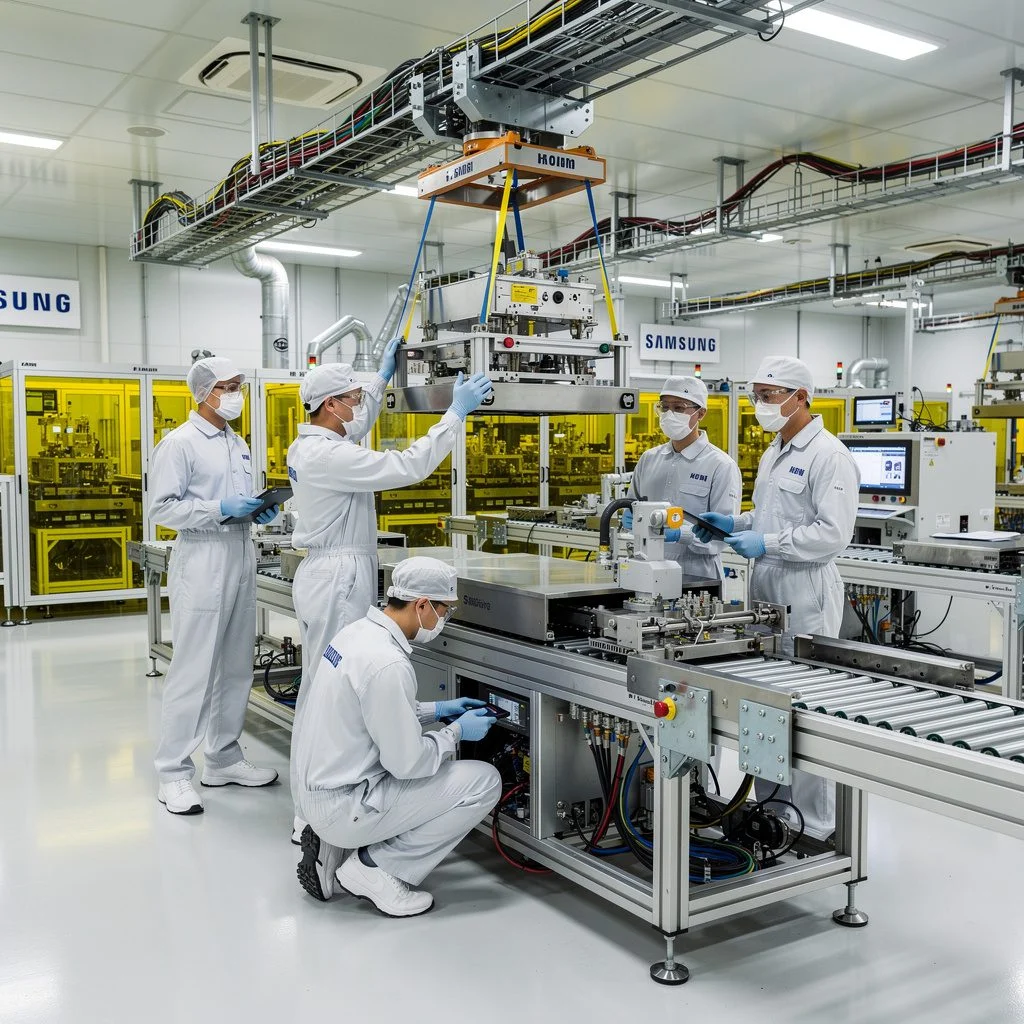
Equipment matters more with each generation. Electronic Times reports that from HBM4, the sixth generation, stacking rises from 12 to 16 layers and a foundry logic process is applied to the base die.
Does Samsung Have the Demand to Fill the Lines?
By the company’s account, demand still leads supply. Newspim reports Kim Jae-joon, vice president of Samsung’s memory division, telling the October 29 third-quarter call that 2027 HBM supply was already sold out at target prices while customers keep requesting more. The same report says Samsung signed long-term memory agreements with 10 large global customers and is negotiating with about 10 more.
Counterpoint Research data cited by Electronic Times shows second-quarter global HBM revenue share of 50% for SK Hynix, 33% for Samsung and 17% for Micron, rounded to 18%.
What Could Disrupt the Build-Out
The first risk is execution. Electronic Times argues the decisive factor is how fast initial yields stabilize, since one faulty die in a stack forces the whole package to be scrapped. The second is demand geography. ZDNet Korea reports major Chinese data-centre operators cut enterprise SSD orders, with Alibaba, Baidu and Tencent named as examples, and that Samsung and SK Hynix are reallocating some of that volume to US customers, with one official expecting the US data-centre shortage to persist into next year and the year after.
Memory bandwidth demand is also widening beyond HBM. SK Hynix reports that its memory-pooling test with a partner cut first-token generation from an average of 80.76 seconds to 15.45 seconds using remote CXL DDR memory. That is a supplier-reported test, not a production benchmark.
What to Watch Next
Three checkpoints matter. Watch whether construction holds the June 2028 line and the May 2029 mass-production date. Watch the bonding-yield curve, since a 16-layer stack leaves little room for a slow ramp. Watch the eSSD reallocation, a signal on where memory capacity clears next. Money Today cites Yole Group projecting advanced packaging grows about 27% a year from 2025 to 2031 and exceeds $51 billion in 2031.
Frequently Asked Questions
How much is Samsung investing at Onyang?
46 trillion won in total: 6 trillion won for construction and 40 trillion won for advanced equipment across five HBM production lines, according to Edaily.
When will the Onyang lines come online?
Samsung targets June 2028 for operations and May 2029 for HBM mass production, as Asia Business Daily reports.
Is 144 trillion won the Samsung Electronics HBM investment?
No. It is the group-wide Chungcheong total across four affiliates; Samsung Electronics’ own commitment is 60 trillion won, so the Onyang HBM spend is the 46 trillion won slice, per Money Today.
How large is Samsung’s HBM market share?
Counterpoint Research data cited by Electronic Times puts Samsung at 33% of second-quarter global HBM revenue, behind SK Hynix at 50% and ahead of Micron at 17%.
Disclaimer: This article is for informational purposes only and does not constitute financial advice. Cryptocurrency investments carry significant risk. Always conduct your own research before making investment decisions.