
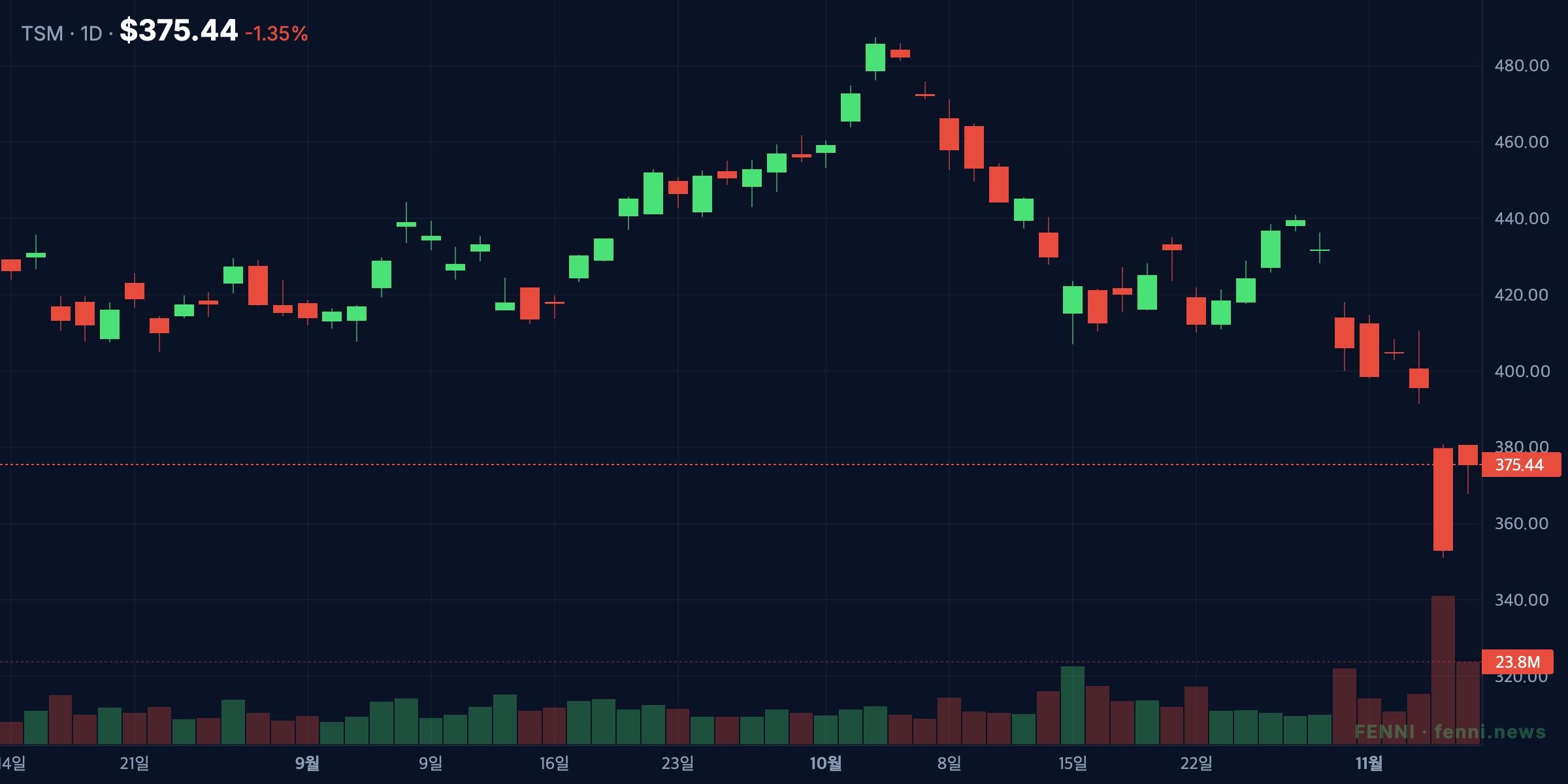
As of November 6, 2026, Taiwan Semiconductor Manufacturing has rarely been easy to explain. The world’s leading-edge logic chips run through its fabs, and the stock still finished the week in a rout. On Thursday, November 5, 2026, TSM fell 10.2% while a broad tech selloff drove the PHLX Semiconductor Index down 12.25% — its second-biggest drop on record — even though the chipmaker’s revenue rose 41.2% year over year to $46.72 billion.
Key Takeaways
- ▲ Yahoo Finance frames Taiwan Semiconductor as a midterm winner because Section 48D grants a credit equal to 35% of qualified investment in U.S. advanced manufacturing facilities
- ▲ Third-quarter revenue reached $46.72 billion, up 41.2% year over year, with full-year 2026 growth expected at about 44% in dollars
- ▼ TSM fell 10.2% on November 5, 2026 and 26.31% over the past month, with the PHLX Semiconductor Index down 12.25% in the same session
- ■ A 24/7 Wall St. price target of $516.16 implies 27.09% upside from $406.13
Why the midterm result counted as a win for TSMC
The policy case rests on a tax provision that predates the vote. According to Yahoo Finance, Section 48D grants a credit equal to 35% of qualified investment in U.S. advanced manufacturing facilities (26 U.S.C. § 48D(a)), and it covers projects that begin construction by December 31, 2026. A credit tied to construction starts inside a fixed window favors building early.
That framing is the source’s argument, not a settled outcome. The rule’s terms are conditional — a project qualifies only if construction begins by the stated date.
Fundamentals that kept strengthening
The October 15 third-quarter report shows revenue of $46.72 billion rose 41.2% YoY and came in above the high end of guidance. EPS of $4.60 per ADR beat the $4.46 consensus, and gross margin reached 66.4%, slipping 1.3 percentage points sequentially on 2nm ramp costs. The company expects N2 capacity to more than double in 2027 and schedules A14 volume production for 2028, with the full-year 2026 outlook lifted to about 44% growth in dollars.
What the November 5 selloff actually repriced
In the cited reporting, TSM stock fell 10.2% on Thursday, November 5, 2026, and 26.31% over the past month, despite the strengthening fundamentals. The same session took the Nasdaq-100 down 6.36% — its worst day since March 2020 — erasing about $2.3 trillion in market value.
What moved was the AI infrastructure schedule. Analysts linked the selloff to fear that the Democratic midterm win could slow AI data center construction, on top of local fights over power grids and water. That is the source’s characterisation of the market’s reasoning.

Where the risk sits for chip investors
A UBS estimate puts about 30% of expected 2028 U.S. data center capacity additions at risk from construction pauses — a figure upstream of any transistor TSMC ships. On valuation, 24/7 Wall St. carries a price target of $516.16 that implies 27.09% upside from $406.13, a third-party model output rather than our fair-value assessment. The milestones that would test it are the 2027 N2 capacity doubling and the 2028 A14 production start.
What to watch next
Three threads decide whether the policy win and the fundamentals re-converge in the share price: construction timing under the 48D window, whether any hyperscaler actually reduces a data center plan, and the 2nm margin trajectory — a 1.3 percentage point sequential slip is manageable once and a trend if it repeats.
Frequently asked questions
Did the midterm result change TSMC’s business?
Not directly as described. The cited reporting ties the win to existing tax code — Section 48D grants a credit equal to 35% of qualified investment in U.S. advanced manufacturing facilities — and the election’s effect runs through expectations about future data center construction.
Why did TSM fall 10.2% after strong results?
The quarterly figures came in above guidance, but the stock traded on the sector’s forward demand outlook. Analysts linked the November 5, 2026 rout, in which the PHLX Semiconductor Index fell 12.25%, to fear that the Democratic midterm win could slow AI data center construction.
Disclaimer: This article is for informational purposes only and does not constitute financial advice. Cryptocurrency investments carry significant risk. Always conduct your own research before making investment decisions.