

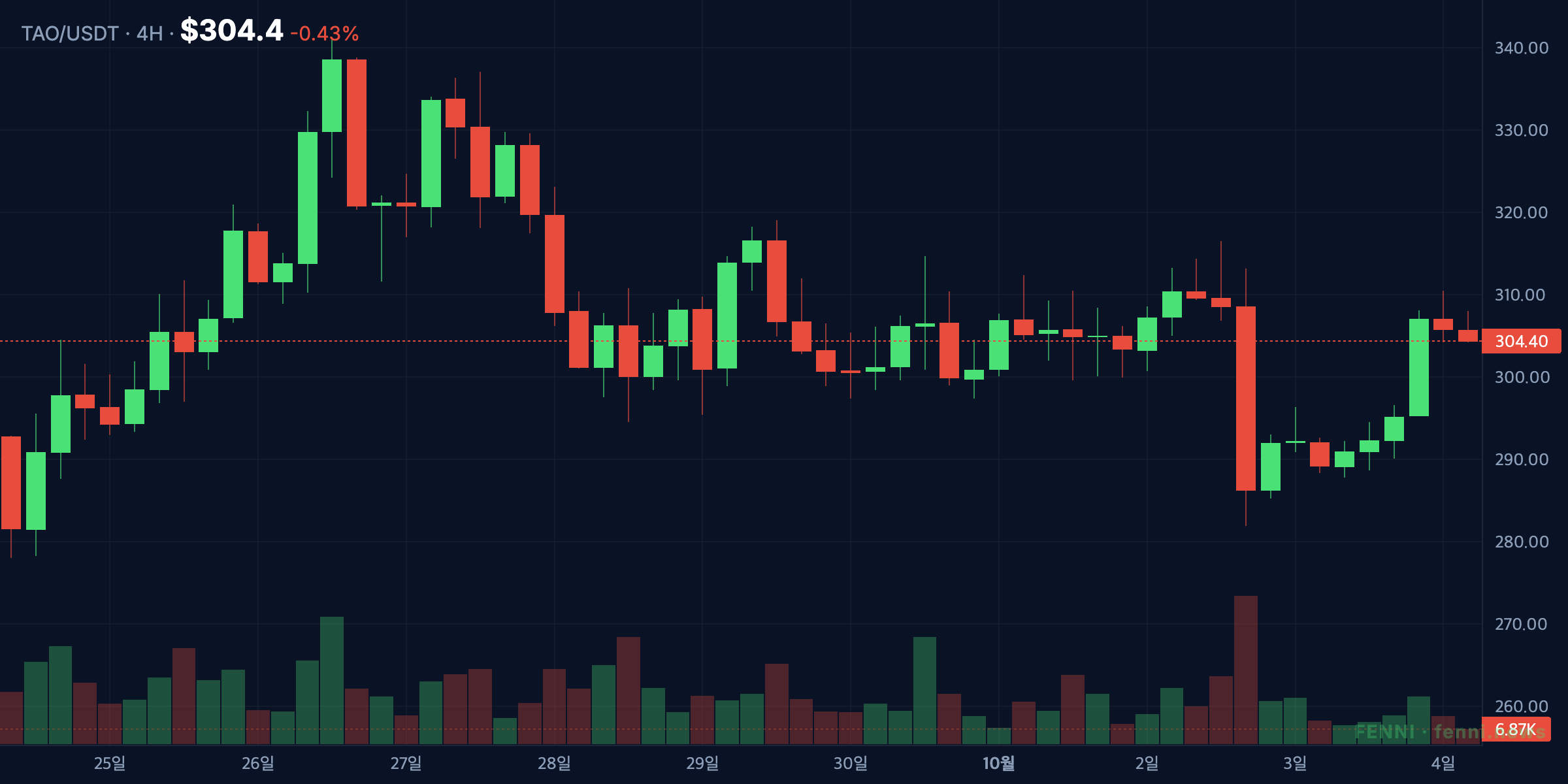
As of October 4, 2026, Bittensor’s TAO token is up 5.8% over the past 24 hours, per a Bybit perpetual (TAOUSDT) snapshot collected October 3, 2026 at 23:12 UTC. This post introduces what the project says it is, what that snapshot shows, and how far the evidence can actually go in explaining the move.
What is Bittensor?
According to the project’s official site, “Bittensor is an open network where independent subnets produce digital commodities and the chain pays contributors in TAO.” The project documentation lists the commodities as compute, inference, storage and prediction, and describes the division of labor: miners produce the commodity, validators score the miners, subnet creators define the incentive mechanism, and stakers back validators with TAO.
The design thesis comes from the project’s whitepaper by Yuma Rao: “We propose a market where intelligence is priced by other intelligence systems peer-to-peer across the internet.” In the mechanism the paper describes, peers rank each other by training neural networks that learn the value of their neighbors, scores accumulate on a digital ledger, and high-ranking peers receive additional weight in the network. Every statement in this section is project-stated — it comes from Bittensor’s own materials, not from an independent assessment.
Listing and market snapshot
The only TAO price figure this article can state is the 24-hour move from the collected snapshot: TAO up 5.8%, a Bybit perpetual reading collected October 3, 2026 at 23:12 UTC and carried as of October 4, 2026. Separately timestamped observations in the same collected set show Velvet (VELVET) up 19.7% (recorded October 3, 2026 at 07:12 UTC), peaq (PEAQ) up 7.5% (October 4, 01:12 UTC) and Zama (ZAMA) up 17.3% (October 4, 03:12 UTC). These are different rolling 24-hour readings taken hours apart — they are individually timestamped observations and do not establish synchronized sector performance, and none is independently verifiable from the project documents reviewed. No market-cap, volume, price-level or supply figure appears in any verified source, so none is cited here, and no listing exchange or listing date is verified in this evidence set.
Why it is moving
No confirmed catalyst appears in the evidence set: there is no verified news event, listing announcement or protocol milestone tied to the move, and because the companion tokens’ 24-hour readings were taken hours apart, the observations do not by themselves establish co-movement or correlation with TAO’s move. The companion projects’ documents describe their own products — Velvet’s documentation describes a social trading terminal with a wallet tracker for following top traders and smart-money flows, alongside AI trading agents; Zama’s litepaper describes confidential smart contracts on existing public blockchains; and peaq’s Purple Paper states, “The bottleneck is no longer intelligence. It is economic freedom.” Those documents say nothing about why TAO moved, and nothing here establishes cause.

Risks and what to watch
- Evidence base: all six sources in this review are project self-published — official sites, documentation and whitepapers. No independent media report, third-party audit, or on-chain or TVL figure backs any claim here, including the companion projects’ descriptions.
- Collusion risk, project-disclosed: the whitepaper itself states that this form of peer-ranking “is not resistant to collusion” and proposes an incentive mechanism it claims makes the system “resistant to collusion of up to 50 percent of the network weight.” That is a project claim, not an independently verified property.
- Snapshot fragility: the 5.8% figure is a single rolling 24-hour reading collected at one moment, and the companion figures are separate readings from other moments — the evidence cannot say whether any of these moves holds or reverts.
Watch items: independent corroboration of the collusion-resistance claim and of subnet economics; whether verified catalyst reporting emerges for the move; and source recency — all six sources were accessed October 4, 2026.
What is Bittensor (TAO)?
Per its official site and documentation, Bittensor is an open network where independent subnets produce digital commodities — compute, inference, storage and prediction — and the chain pays contributors in TAO. The whitepaper frames it as a peer-to-peer market where intelligence is priced by other intelligence systems.
Why did TAO move today?
TAO gained 5.8% over 24 hours as of October 4, 2026, per a Bybit perpetual (TAOUSDT) snapshot collected October 3, 2026 at 23:12 UTC. The companion tokens’ 24-hour figures — VELVET up 19.7%, ZAMA up 17.3%, PEAQ up 7.5% — are separately timestamped observations taken hours apart and do not establish synchronized sector performance. No confirmed catalyst exists in the evidence set.
Where does the price data in this article come from?
From the collected market-data snapshot: a Bybit perpetual TAOUSDT reading taken October 3, 2026 at 23:12 UTC and carried as of October 4, 2026. The official project documents reviewed contain no price data, so no other price or volume figure is cited.
Disclaimer: This article is for informational purposes only and does not constitute financial advice. Cryptocurrency investments carry significant risk. Always conduct your own research before making investment decisions.