
As of November 3, 2026, CoinMarketCap describes Sophon as a technology studio building at the intersection of consumer finance and AI, and its listing page also carries the market data for a small-cap token that is no longer a chain story. On that date, the listing records SOPH at $0.001446 and #995 by market capitalization, a position 98.7% below the token’s all-time high. What makes the coin worth a closer look is not the price itself but the transition around it: according to Sophon’s official documentation, the project has “evolved from a general-purpose ZK chain into a technology studio building onchain consumer experiences,” and the network it launched with is being wound down on purpose. For anyone holding or evaluating SOPH, the question is how a token replaces gas-fee and staking demand with a buyback-and-burn model, and how much of that model is a stated plan rather than a record of results.
Key Takeaways
- ▼ According to CoinMarketCap, SOPH traded at $0.001446 on November 3, 2026, and CoinMarketCap records the token 98.7% below its all-time high.
- ▼ According to Sophon’s official website, SOPH gas-fee and staking utility is being phased out alongside the chain, ending chain-based demand for the token.
- ▲ According to Sophon’s official website, revenue from the project’s consumer products is meant to fund SOPH buybacks that are then permanently burnt.
- ■ According to Sophon’s official website, the first burn of over 46.5 million SOPH came from the staking rewards pool and node buybacks, not from product revenue.
- ■ According to Sophon’s migration guide, the chain remains live, with the exact decommissioning date to be announced in advance.
What is Sophon?
Sophon now describes itself as a technology studio rather than a blockchain network. According to Sophon’s official documentation, “Sophon has evolved from a general-purpose ZK chain into a technology studio building onchain consumer experiences,” with its applications being built on Base while the original Sophon Chain is wound down in a planned transition. The same documentation states that new deposits into the Sophon Chain have been disabled since June 25, 2026, and tells holders to review the migration guide and withdraw assets before the final decommissioning date; that deposit block has held continuously from June 25, 2026 through the date of the project’s documentation.
The CoinMarketCap listing carries a shorter version of the same story. Its summary describes SOPH as a technology studio building at the intersection of consumer finance and AI, and says the company previously operated a ZK-powered layer-2 blockchain before sunsetting that chain in June 2026. It names Pyre, a self-custodial neobank, as the first application to go live, and frames the token as exposure to the project’s full product portfolio rather than to a single app.
Overview
The mechanics of the transition are spelled out on Sophon’s official website. The project states that SOPH currently serves two purposes, gas fees on the Sophon network and staking, and that “Both utilities will be phased out alongside the chain.” Staking is discontinued when the chain is decommissioned, and the project says any SOPH a holder unstakes becomes claimable on Ethereum mainnet.
The replacement is a buyback-and-burn programme. According to the project, “The chain-era utility for SOPH is being replaced by a buyback-and-burn programme funded by real product revenues,” and a portion of product profits is to be used to purchase SOPH from the open market. The project draws one explicit design line: “bought-back SOPH will not be redistributed to token holders”, because redistribution would create sell pressure without lowering circulating supply, so acquired tokens are to be permanently burnt instead.
The revenue side rests on Pyre. Sophon’s website names three streams feeding the programme: interchange fees on card transactions, vault performance fees on all vault usage, and PYRUSD reserve yield earned on the reserves behind the project’s stablecoin, which it describes as its primary settlement currency. In the project’s framing those are recurring, volume-driven streams, so the programme’s scale would track product volume rather than chain activity.
The first burn is already done. Sophon’s website states that the project burnt over 46.5 million SOPH on June 28, and that “This SOPH comes from the unutilised staking rewards pool and node buybacks.” Revenue-funded buybacks are described as following later. The distinction matters for anyone reading a burn figure as evidence of product traction: the first burn was funded from existing token pools, not from the product revenues the new model is built around.
Supply and market data come from CoinMarketCap. The page reports a price of $0.001446 with 24-hour trading volume of $55,230,075, and a market capitalization of $8,597,448. It also reports a circulating supply of 5,944,772,184 SOPH against a maximum supply of 10,000,000,000. The same statistics table lists a fully diluted valuation of $14.46M and a 24-hour volume-to-market-cap ratio of “Vol/Mkt Cap (24h) 643.83%”.
The token’s home chain is Ethereum. According to the project’s migration guide, “SOPH has always been a token native to Ethereum L1. The version on Sophon mainnet is simply the bridged copy of it,” with the Ethereum deployment listed in the official address table as 0x6B7774CB12ed7573a7586E7D0e62a2A563dDd3f0. The Guardian node programme, through which holders of Guardian NFT memberships earn a pro-rata share of 20% of the total SOPH supply, continues under the project’s stated terms after the last vesting unlock on Sophon on September 29, 2026.
Price Outlook
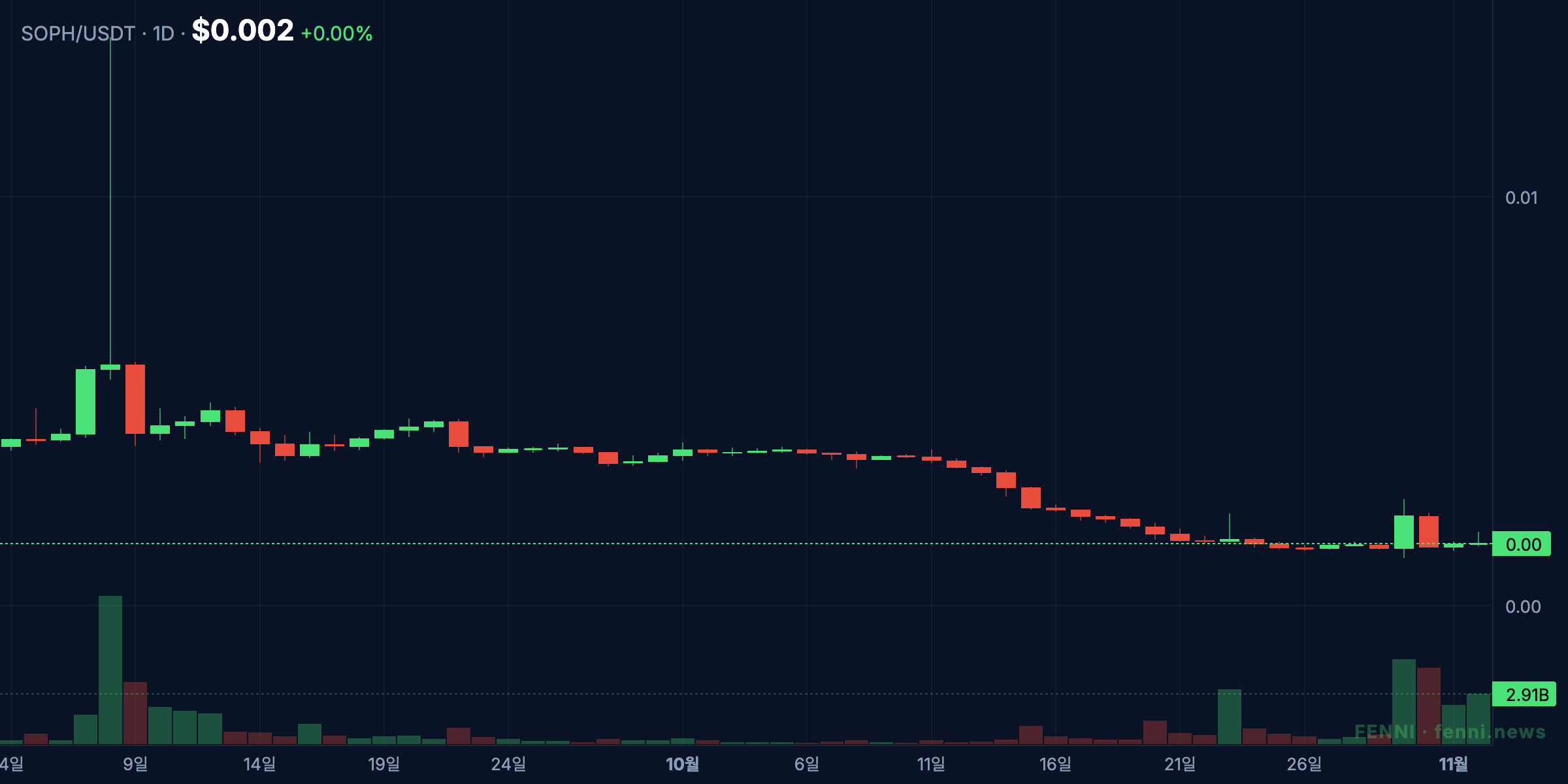
As of November 3, 2026, according to CoinMarketCap, SOPH traded at $0.001446, down 14.97% over the prior 24 hours. As of November 3, 2026, according to CoinMarketCap, 24-hour trading volume was $55,230,075. As of November 3, 2026, according to CoinMarketCap, SOPH ranked #995 by market capitalization.
As of November 3, 2026, according to CoinMarketCap, the 24-hour low sits at $0.001421 with the 24-hour high at $0.002294. As of November 3, 2026, according to CoinMarketCap, the reported all-time high is $0.1105 from May 28, 2025 and the recorded all-time low is $0.001196 from October 30, 2026. As of November 3, 2026, according to CoinMarketCap, the volume-to-market-cap ratio is the data point to watch, because the statistics table sets a 24-hour turnover of $55.23M against a market capitalization of $8.59M with a “Vol/Mkt Cap (24h)” line reading “643.83%”.
As of November 3, 2026, according to Sophon’s migration guide, there is no hard date yet for the chain shutdown and the chain “will stay operational until late 2026 (the exact decommissioning date will be announced well in advance)”. As of November 3, 2026, according to CoinMarketCap, the page also carries a related-article headline reading “Sophon Sets Nov. 30 Mainnet Shutdown, Nov. 25 Withdrawal Deadline”, but no body text for that item appears alongside it, so those dates stand unconfirmed and conflict with the project’s own account.

Risks and what to watch
The first risk is the revenue dependency. The buyback-and-burn programme is designed around product revenues from Pyre and the project’s other products, and Sophon’s website says that model is funded from interchange fees, vault performance fees, and reserve yield. The project markets Pyre as a waitlist product, so the revenue scale behind the burn is not evidenced in the material available, and the only burn completed so far came from staking rewards and node buybacks rather than revenue. A holder evaluating the new utility model is therefore evaluating a design, not a demonstrated revenue stream.
The second risk is operational and time-bound. According to Sophon’s official documentation, deposits into the Sophon Chain have been disabled since June 25, 2026, and holders of assets on the network are told to withdraw before the final decommissioning date, which the project has not yet fixed. Staking ends at decommission. For anyone still holding bridged SOPH or other assets on the old network, moving the asset out is the only remaining route.
The third risk is market structure. CoinMarketCap’s statistics table lists a market capitalization of $8,597,448 against a 24-hour volume-to-market-cap ratio of 643.83%, and a circulating supply of 5,944,772,184 SOPH against a 10,000,000,000 maximum. Those are reported figures only; the distribution schedule for the remaining supply is not described in the sources reviewed here, and no conclusion about future selling pressure follows from them.
What to watch, on the project’s own terms, is the completion of the chain wind-down and the arrival of revenue-funded burns. Both remain forward-looking: the project says the exact decommissioning date will be announced well in advance, and that ongoing buybacks funded by Pyre’s revenues “will follow throughout the year.”
Frequently asked questions
What is Sophon, and what does the SOPH token represent?
According to Sophon’s official documentation, the project is a technology studio building onchain consumer experiences, having moved away from operating a general-purpose ZK chain. According to CoinMarketCap’s listing summary, the SOPH token represents exposure to the project’s full product portfolio.
What happens to SOPH when the Sophon Chain is wound down?
According to Sophon’s official documentation, new deposits into the Sophon Chain have been disabled since June 25, 2026, and holders should withdraw assets before the final decommissioning date. According to the project’s website, staking is discontinued at the same time and any unstaked SOPH becomes claimable on Ethereum mainnet, while SOPH itself needs no migration because it was always native to Ethereum L1.
How does the buyback-and-burn programme work?
According to Sophon’s official website, a portion of profits from the project’s product revenue streams is used to purchase SOPH from the open market and the tokens are permanently burnt rather than redistributed to holders. According to the same source, the first burn of over 46.5 million SOPH on June 28 came from the unutilised staking rewards pool and node buybacks, with revenue-funded buybacks to follow later.
Disclaimer: This article is for informational purposes only and does not constitute financial advice. Cryptocurrency investments carry significant risk. Always conduct your own research before making investment decisions.