

Lombard (BARD) is the token attached to a project that presents itself as Bitcoin finance infrastructure, and on November 13, 2026 its price and trading volume both moved sharply inside a single day. As of November 13, 2026, according to CoinMarketCap, BARD traded at $0.138721 with 24-hour volume of $124,731,148 and ranked #318 by market capitalization. The move arrived one day after the token set its all-time low, leaving the market with a violent bounce inside a much deeper drawdown. This overview sets out what the project says it is, what the dated market snapshot shows, and which figures matter next.
Key Takeaways
- ▲ As of November 13, 2026, CoinMarketCap recorded Lombard up 71.49% in the last 24 hours at a price of $0.138721.
- ■ The collection of sources reviewed for this article gives no reason for the move, so no catalyst is asserted here.
- ▼ The capture places the price 91.84% below the all-time high of $1.72 set on March 05, 2026.
- ■ Only 396,562,500 BARD of a 1,000,000,000 max supply circulated, and FDV of $138.72M stood well above the $55,011,490 market cap.
- ▼ Every product, integration and security claim in this article originates with the project’s own materials.
What is Lombard?
Lombard’s own documentation opens with a positioning statement: “Lombard is a leading Bitcoin finance protocol with $3 billion in Bitcoin onboarded,” according to Lombard’s docs. The same page states that the project was founded in 2024 and is backed by Polychain Capital, Franklin Templeton, and Binance Labs. Both points come from the project itself; no independent reporting on the company appears in the materials reviewed here, so they are reported as the project’s own account rather than as established fact.
The docs describe five products: LBTC, BTC.b, the Lombard SDK, Bitcoin Smart Accounts and Bitcoin Earn. Per the project, these enable Bitcoin holders, corporate treasuries and financial institutions to earn yield on, borrow against, and deploy their Bitcoin onchain. Lombard’s website also carries a product announcement stating that LBTC is moving to institutional yield with a strategy managed by Bitwise and a net APY target of 2.5%, according to Lombard’s website. That yield figure is the project’s stated target, not a return observed in this snapshot.
On reach, the docs state that Lombard’s infrastructure powers Bitcoin products for the users of Ledger, Binance and Bybit, and integrates with Aave, Morpho and 50+ DeFi protocols across 10 blockchains. The website carries the matching usage figure: “Over 270,000 Bitcoin holders are generating yield, using Bitcoin as collateral, and trading across the onchain financial system with Lombard.” The website also lists $3B+ BTC onboarded, 70% yield-bearing BTC market share, 50+ protocol integrations and 270,000 users. All of these are project-stated counters.
BARD itself is covered in the docs’ Token Economics section, which the project says sets out BARD supply, distribution, and the Lombard Finance Foundation. The docs were last updated on November 9, 2026, four days before the market snapshot below.
Overview
How the protocol secures minting and bridging is described on the project’s own security page. The website states that every mint, burn, and bridge transaction is validated by a 12-member Security Consortium made up of independent institutions with “entirely uncorrelated security setups,” and that minting requires approval from 10 of 14 validators, according to Lombard’s website. The page also counters that with a “Consortium Members” figure of 12. Those two counts and the validator count of 14 are reported exactly as the project publishes them and are not reconciled into a single number here.
On the token side, the dated snapshot supplies the structural facts. As of November 13, 2026, according to CoinMarketCap, circulating supply was 396,562,500 BARD against a max supply of 1,000,000,000 BARD, which the source gives as 39.65625% of the maximum. The same capture records a market cap of $55,011,490 and a fully diluted valuation of $138.72M, with 18.63K holders. Judged only on those two figures, the fully diluted valuation sits at roughly 2.5 times the circulating market capitalization.
That gap is a statement about float, not a price view. With roughly 40% of the maximum supply in circulation, the market capitalisation reflects the tokens that exist now, while the fully diluted figure assumes the full supply. The project does not, in the material reviewed here, publish an unlock schedule or a distribution timetable that this article can restate, so the size and timing of any future float change remain outside what the sources state.
Two further counters from the same capture frame the token’s scale: the project’s own website counts 270,000 users, while CoinMarketCap counted 18.63K BARD holders on November 13, 2026. Those measure different things — platform participants versus onchain token addresses — and are not interchangeable.
Price Outlook
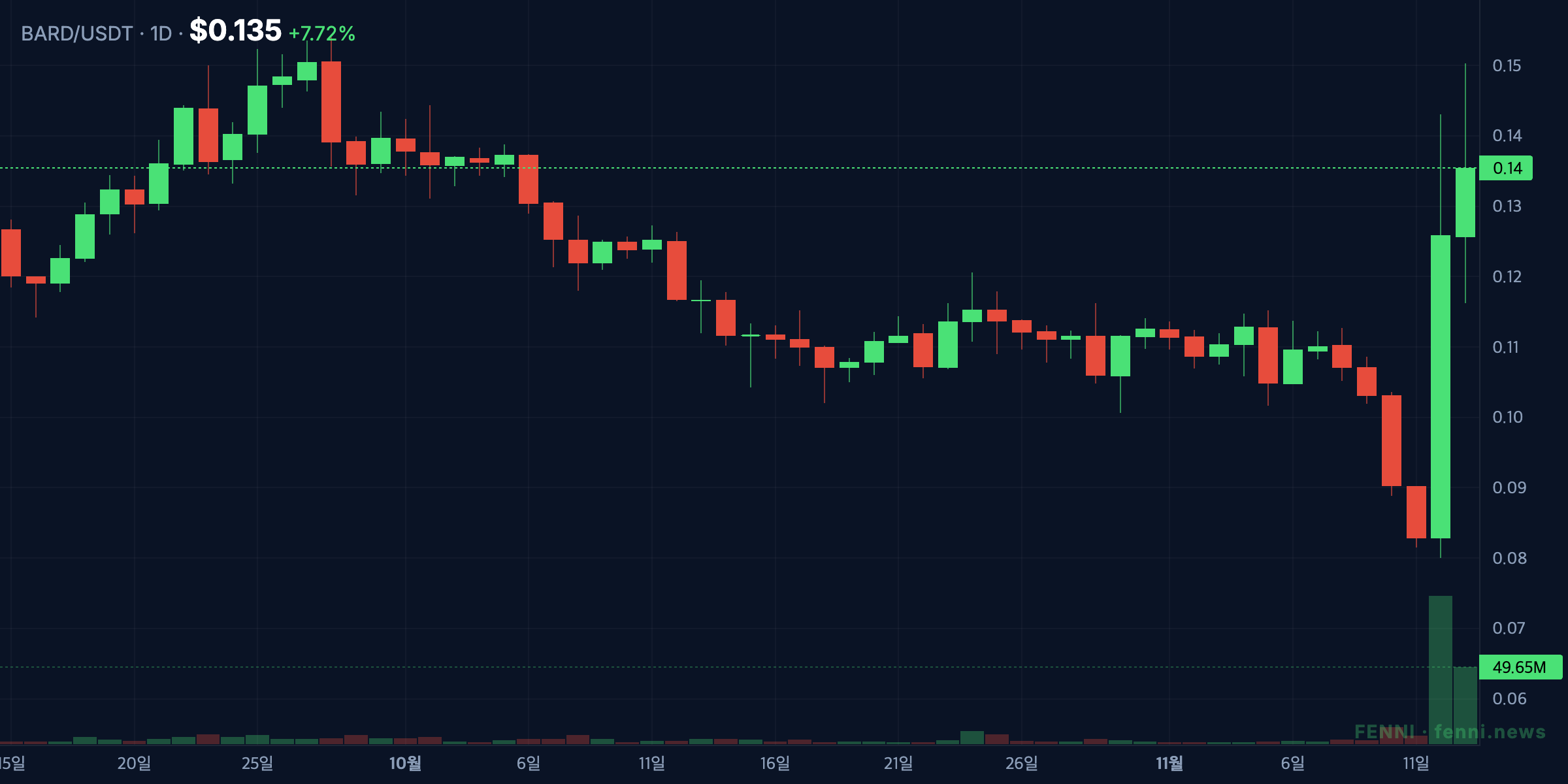
As of November 13, 2026, according to CoinMarketCap, Lombard traded at $0.138721, up 71.49% over the prior 24 hours.
As of November 13, 2026, according to CoinMarketCap, 24-hour trading volume was $124,731,148, reported as up 1555%, and volume over market cap for the 24-hour period stood at 226.58%.
As of November 13, 2026, according to CoinMarketCap, the 24-hour low was $0.08037 and the high was $0.1481, and the all-time low of $0.08037 was set on November 12, 2026, with the price up 74.27% from that level.
As of November 13, 2026, according to CoinMarketCap, the all-time high was $1.72, set on March 05, 2026, and the captured price was 91.84% below it.
Risks and what to watch
Supply overhang is the first structural risk visible in the snapshot. As of November 13, 2026, according to CoinMarketCap, 396,562,500 BARD circulated against a max supply of 1,000,000,000 BARD, with FDV of $138.72M against a $55,011,490 market cap. A float of just under 40% means the circulating market capitalisation describes a token whose fully diluted valuation is materially larger, and how and when the remainder enters circulation is not stated in the material reviewed here.
Volume behaviour is the second. The capture records 24-hour volume of $124,731,148, up 1555%, and a volume-to-market-cap ratio of 226.58% while the price rose 71.49% in the same window. Those figures are stated side by side exactly as published; they are not evidence of accumulation, distribution, or any particular order-book condition, since no source describes the trading mechanism behind them.
Drawdown is the third. A one-day gain of 71.49% measured on November 13, 2026 sits inside a 91.84% decline from the March 05, 2026 high of $1.72, and the same capture shows the token at $0.138721 within a 24-hour range of $0.08037 to $0.1481. A single session of that width is a measurement of one window, not a trend.
Evidence asymmetry is the fourth. The $3 billion onboarded, the 50+ integrations, the 270,000 users, the targeted yields and the security consortium description all come from Lombard’s own documentation and website. With no independent source in the set, a reader has no external check on any of those operating figures.
Two data points are worth watching in future captures, because both are already ambiguous on the project’s own surfaces: the Security Consortium is described once as a 12-member body and once as a group of 14 validators, and the counts are not reconciled. Separately, the CoinMarketCap page changed between the original fetch and a recheck on November 13, 2026, so every figure quoted here should be read as a dated value that may differ on a later read.

Frequently asked questions
What is Lombard (BARD)?
Lombard is a protocol that describes itself as “a leading Bitcoin finance protocol with $3 billion in Bitcoin onboarded,” according to Lombard’s docs, offering LBTC, BTC.b, the Lombard SDK, Bitcoin Smart Accounts and Bitcoin Earn so holders and institutions can earn yield on and borrow against Bitcoin onchain. BARD is the token attached to that protocol, and its market data is published by CoinMarketCap.
How is BARD’s supply and market structure set up?
As of November 13, 2026, according to CoinMarketCap, 396,562,500 BARD circulated out of a 1,000,000,000 max supply, equal to 39.65625% of the maximum, while market cap stood at $55,011,490 and FDV at $138.72M, with 18.63K holders. All of those are dated values from that capture and will change.
Why did BARD’s price move?
The sources reviewed for this article do not state a cause for the move. As of November 13, 2026, according to CoinMarketCap, Lombard was up 71.49% in the last 24 hours at $0.138721, one day after the all-time low of $0.08037 on November 12, 2026, and the price remained 91.84% below the $1.72 high of March 05, 2026.

Disclaimer: This article is for informational purposes only and does not constitute financial advice. Cryptocurrency investments carry significant risk. Always conduct your own research before making investment decisions.