
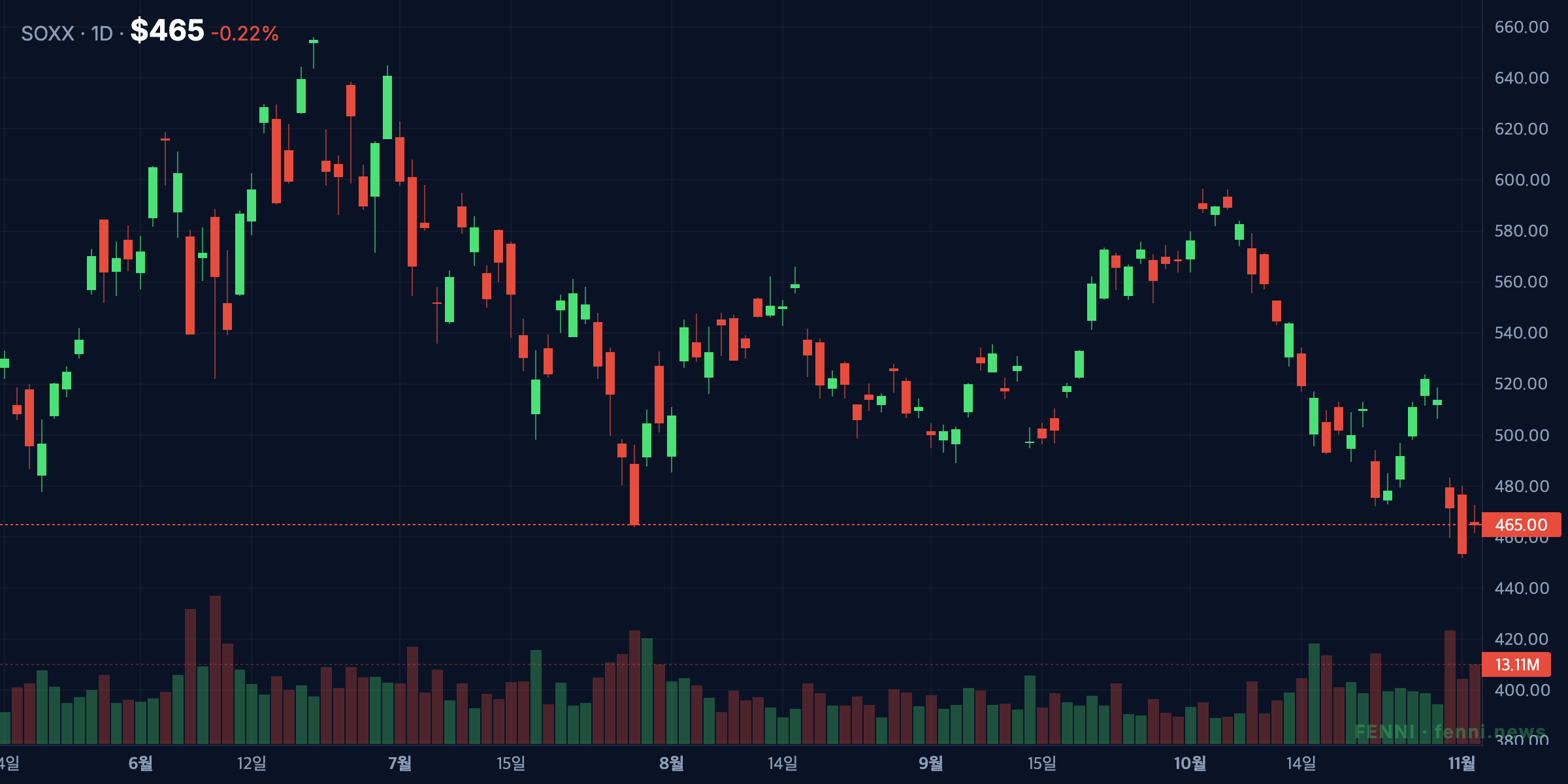
As of Nov. 3, 2026, the PHLX Semiconductor Index (^SOX) had finished the prior session about 22% below its Oct. 6, 2026 high, its second bear market since June, and it was also the index’s second straight close below its 200-day moving average. One session later the tone flipped: nearly every chip and storage stock in the S&P 500 had risen in early trading on Tuesday, Nov. 3, while the consumer staples, utilities and real estate names that carried the market through October slipped. What looks like a reversal is still an unconfirmed one — a fresh bear market one day, a broad bounce the next, with the group’s own overhead resistance untouched and a $3.7 trillion valuation hole to fill.
Key Takeaways
- ▼ The SOX closed Nov. 2 about 22% below its Oct. 6 high, a second bear market since June, according to Yahoo Finance.
- ▲ Nearly every chip and storage stock in the S&P 500 rose in early trading Tuesday, and Micron, Nvidia and AMD rallied 2%, 3% and 5% respectively, per Yahoo Finance.
- ■ Chip and memory stocks have lost about $3.7 trillion in market value since Oct. 6, by Yahoo Finance calculations.
What Put Chip Stocks in a Fresh Bear Market?
Monday’s close was the trigger. The PHLX Semiconductor Index tumbled 3.37 percent on Nov. 2, according to The Herald Business, with Micron down 5.78%, AMD down 7.52% and Intel down 8.80%. The damage stacked up across the complex: chip and memory stocks have lost about $3.7 trillion in market value since Oct. 6, by Yahoo Finance calculations reported by Yahoo Finance, and the Nasdaq-100 closed more than 10% below its all-time closing high on Monday, confirming a correction as investors grow wary of Big Tech’s soaring AI spending and little evidence of adequate returns, according to Investrade.

Why Did Chip Stocks Bounce on Tuesday?
The bounce was broad rather than narrow. According to Yahoo Finance, semiconductor stocks rebounded Tuesday with Micron up 2%, Nvidia up 3% and AMD up 5% after steep losses, while SK Hynix and the memory and storage names Sandisk, Seagate and Western Digital also opened higher. Investrade described chip stocks as among the top gainers, bouncing back after the SOX fell well below a key technical support level Monday, ahead of AMD’s results.
AMD had its own catalyst. Advanced Micro Devices rose 5% in the morning, hours before its third-quarter report, after Lynx Equity Strategies turned bullish, with the team led by KC Rajkumar citing demand for Venice, AMD’s 192-core, 2-nanometer server CPU, according to Yahoo Finance.
Yahoo Finance framed the follow-through conditionally: if chips can hold that ground, Monday’s breakdown starts to look like a bear trap. The same report puts the technical bar first — the iShares Semiconductor ETF needs to clear its long-term moving average, near $477, to start repairing the damage, with about $524 and $596 as the next levels cited.
Safe Havens Slipped as Chips Recovered
Leadership changed hands quickly. Roughly two-thirds of S&P 500 stocks fell in early trading Tuesday, a mirror image of Monday, when about 7 in 10 rose while chips sank, and consumer staples, utilities and real estate — the safe havens that carried the market through October — slipped, according to Yahoo Finance. The October record makes the turn sharper: from the Oct. 6 close through Nov. 2, staples and health care climbed about 10% to 11%, while SOXX fell 23%, by Yahoo Finance calculations.
The earnings-linked signal cut both ways. Investrade noted Apple shares slid after the company warned that rising memory costs would squeeze gross margins, and Yahoo Finance quoted Luke Kawa of Sherwood News calling the seesaw between Apple and chips “almost Pavlovian.”

Are Chip Fundamentals Still Intact?
Earnings argue against treating the selloff as a demand recession. According to a 24/7 Wall St. review published by Yahoo Finance, third-quarter revenue reached $46.72 billion, up 41.2% in U.S. dollar terms, with gross margin at 66.4% and operating margin at 58.7%; management raised its full-year 2026 outlook three times in a row.
Demand signals on the server side point the same way. Intel’s data center and AI revenue jumped 78% to $7.3 billion in the third quarter, per Yahoo Finance, while AMD guided on its August call for server revenue to grow more than 70% in 2027 after more than 80% in the second half of this year.
Counterweights exist. Taiwan News reported that memory bellwethers Nanya Technology, Winbond Electronics and Phison Electronics all hit their daily limit-downs on Tuesday as DRAM price increases slowed. The same session, the TAIEX fell 1,612.6 points, or 3.59%, to close at 43,307.54, its seventh-largest closing point decline on record, with TSMC down 1.5% to NT$2,295, MediaTek down 7.43% and ASE down 8.61%, according to Taiwan News.
What Should Investors Watch Next?
Earnings are the nearest test the sources name: the Investrade note flagged AMD results that evening as the catalyst, with midterm results rolling in overnight. Beneath the chart, the SOXX levels near $477, $524 and $596 mark the repair path described by Yahoo Finance.
On the macro side, The Herald Business reported that markets priced in a 73.2 percent probability that the Federal Reserve will raise its benchmark interest rate by 0.25 percentage point in December, with the ISM manufacturing PMI at 55.5 and its prices index at 75.2. For the past record only, Yahoo Finance noted that chip stocks have climbed in all eight midterm cycles since 1994, measured from the last October close through the following June — a historical tally, not a forecast.
Frequently Asked Questions
How large was the semiconductor drawdown?
The PHLX Semiconductor Index finished Nov. 2 about 22% below its Oct. 6 high, its second bear market since June, according to Yahoo Finance. From the Oct. 6 close through Nov. 2, SOXX fell 23%, by Yahoo Finance calculations.
Did the bounce confirm a bottom?
No source describes it as a confirmed bottom. Yahoo Finance said that if chips can hold their ground, Monday’s breakdown starts to look like a bear trap, and that SOXX needs to clear its long-term average near $477 to start repairing the damage.
Why did safe-haven sectors fall while chips rose?
The sources record the two moves together without a stated cause: consumer staples, utilities and real estate slipped as chips bounced on Tuesday, according to Yahoo Finance.
What did TSMC’s latest results show?
Third-quarter revenue reached $46.72 billion, up 41.2% in U.S. dollar terms, with gross margin at 66.4% and operating margin at 58.7%, according to the 24/7 Wall St. review published by Yahoo Finance.
Disclaimer: This article is for informational purposes only and does not constitute financial advice. Cryptocurrency investments carry significant risk. Always conduct your own research before making investment decisions.